Search

Nonsensical Times

Exploring the wonderful world(s) of sense-making

Category

Uncategorized

Widdershins

Widdershins: “in a left-handed, wrong, or contrary direction: counterclockwise.”

~Merriam Webster

I absolutely love this word, so I chose to write a poem about it. Sometimes, a word is all it takes to inspire a poem. It doesn’t matter if it is a good poem or not. Especially, if the word is widdershins. One would expect such a poem to somehow turn out wrong. So, in that spirit, please accept this amateur attempt.

Widdershins

By Bonnie Tulloch

Widdershins! Oh, Widdershins!

Where have I placed my head?

Somewhere in the midst of dreams,

Did it fall off my bed?

Widdershins! Oh, Widdershins!

How am I to think?

My thoughts are playing cricket,

My logic’s on the brink.

Widdershins! Oh, Widdershins!

Where did my mind go?

It’s thirty minutes past the time

That I ought to know.

Widdershins! Oh, Widdershins!

What is there left to say?

The clouds are in the kitchen,

My sense ran off to play.

Widdershins! Oh, Widdershins!

This is an awful mess.

The world is crazy and absurd,

So weird, I must confess:

That of all the words that I could wear,

Widdershins is my dress.

The next time you experience a widdershins day try making a poem out of it. You might not be able to turn back the clock, but it is fun smashing it every now and then with a good laugh. Sometimes, the wrong move creates the right moment, especially if it brings a smile to your face.

Nonsense & Grief

“We do live in a ridiculous world, and I would not wish to talk about the world without indicating confusion and sadness, but also my vision and hope, concerning our shared human condition.”

~Douglas R. Hofstadter, Introduction to Metamagical Themas 

Today I want to explore the heavier side of nonsense. Maybe “want to” are not the right words. Maybe “have to” or “need to” are more accurate.

Over the past few weeks, I have been confronted with several tragedies. Three young people I know have passed away from cancer. Their vibrant lives have been cut short by illness and I am having a hard time making sense of it all.

Why them?

Why now?

Why?

The weight of this news lies heavy on my heart and mind. Nothing can reason away the devastation of losing these precious people.

When faced with such a senseless situation, how do we respond?

We grieve. We let the weight of life’s mysteries sink into our souls. We retreat into the question that forms the core of our existence: Why are we here? 

Everyone answers this question differently. It has divided humans for centuries.

And yet, at times like this, it also unites us. When we stare into the eyes of a grieving friend or family member, we recognize the confusion we see in their faces. We share their pain. We share their hurt. We share their suffering.

Grief, in this sense, offers clarity amidst confusion.

When faced with the question: Why are we here?

Grief answers: To LOVE.

After all, what is grief, but a testament to love?

It is a reminder that love is what makes life worth living. When we lose love, we lose life.

That is the true beauty of our humanity. Amidst such horrible loss, we have the capacity to feel the highest emotion.

The beautiful side of grief is its ability to inspire us to live our lives more intentionally–its ability to inspire us to lay aside our differences and to love each other more fully and deeply.

Love, of course, does not always make sense to our minds. Not all people are easy to love and sometimes we wonder if it is worth the effort it takes.

When confronted with death, however, it is love that makes the most sense to our hearts. We wish we could have loved more, not less.

The greatest gift grief has given me is the realization that there are more opportunities to love than I ever knew.

And that is what I want to do. That is why I am here. Like my friends who have passed on, I want to live a legacy of love.

Whatever you may be grieving today, I want to encourage you that you are not alone. Grief is part of the human condition. But so is love. And the greatest way to receive love is to give it. So from my heart to yours please accept this wish that your grief will find a beautiful expression in the love and support you share with others.

Blind Faith

“The meme for blind faith secures its own perpetuation by the simple unconscious expedient of discouraging rational inquiry.” ~ Richard Dawkins, The Selfish Gene

Sometimes, I wonder at the ways in which the words “faith” and “reason” are thrown around. We all have faith in something. We all have ideas. We all have beliefs. We all have our reasons for believing what we do.

And yet, there is this lingering assumption that “rational inquiry” does not require faith. This seems strange to me, as the very use of the term “rational inquiry” inspires a sense of confidence–of trust in a certain way of thinking. To believe in the power of “rational inquiry” one has to have faith in it.

What does it mean, then, to have blind faith?

To answer this question, we first have to uncover the meaning of blindness. The dictionary suggests that to be blind is to have a lack of sight–a lack of perception, awareness, or discernment.

I don’t know about you, but the privileging of a singular “rational inquiry” suggests a lack of perception and awareness to me of other forms of reason. Too often, anything outside of this form of thinking is automatically labeled “irrational,” tossed into the rubbish heap of nonsense. So much human reason is kicked to the curb, because it doesn’t fit the boundaries of a narrowly developed, “rational” logic.

Under the governance of this “rational inquiry,” humanity becomes a landfill of nonsensical beliefs. To the “rational” people, this illogical thinking is an eyesore. It stinks. And the problem just keeps getting bigger and bigger, which makes it harder for people to pretend it’s not there.

There are, however, other interpretations of blindness. Like Tiresias in the Oedipus myth, there is the notion of the blind prophet–the seer. He sees more clearly than anyone else.

Why does he see more clearly than everyone else?

Because he is not blinded by sight–he is not blinded by one form of reason.

On the contrary, true blindness leads to the enhancement of other senses. Perception increases in different ways when we are forced to rely on sound, smell, touch, and taste.

You engage with the world differently. You see it differently. You know it differently.

Unlike the first definition, this kind of blindness does not represent a lack of perception, but rather, an abundance of it.

In other words, an appreciation of different forms of thinking does not represent blindness, as much as it does an awareness of the nature of human subjectivity. Once we start to degrade alternative forms of thinking we run the risk of blinding ourselves to the weaknesses of our own thoughts. We question the foundation of our shared humanity: free will.

When we start to trash the choices of others, we unconsciously belittle our own choice. That goes for any system of reasoning. If it isn’t strong enough to stand competition, it ultimately is not as sovereign as it claims to be.

Those with the greatest confidence in their beliefs will trust them to demonstrate the value of their own logic without disparaging others. They will respect people’s choices, because they respect their own right to choose.

After all, faith in any system of reason requires faith in humanity.

Once any form of “rational inquiry” starts to belittle humanity, then we are in danger of losing our own.

I encourage you to see through many senses today. Instead of judging people, inquire about them. Ask. Learn. Understand. Even if you disagree, you will experience the satisfaction of seeing the world through another pair of eyes. Exercise a little faith in humanity, and you might be surprised at what you discover.


Discomfort, Creativity & Nonsense

“It may be currently possible to be both creative and comfortable. We suspect it isn’t, but our suspicions are not scientific data.” ~ Victor Goertzel & Mildred Goertzel

Anyone who has ever had a creative idea knows the discomfort that comes with it. Sure, there is an amazing thrill when the lightning bolt of inspiration strikes, but then there is the downpour of doubt that follows. Brainstorms are beautiful, but they are also risky. Once you’ve been struck by a new idea and felt its electric currents it is almost impossible to walk away from the experience unscathed.

Walking away from that creative storm, you feel a responsibility to the lightning bolt in your head. Such a power source needs to be shared with the world–it is too much for one person to carry. But how do you channel that energy? How do you conduct that idea safely into reality?

The answer is simple: You experiment.

You take a chance.

You risk failure.

And you weather the results.

You see, creative forecasts often encompass many storms. They encompass many moments of self-questioning, of disbelief, disappointment, and discouragement. They go against the logic of self-preservation, of protecting ourselves from the dangerous elements. Maybe that is why creative people are often seen as crazy. Only crazy people take such risks.

And yet, there is a logic to creative people’s discomfort. When we are comfortable, we settle for less. When we are uncomfortable, we refuse to settle. We keep searching and trying. We keep learning. We keep growing.

You see, storms not only make us stronger, they also make us smarter. Once we’ve weathered a few, we can see beauty in the chaos. We can accept them as a necessary part of life. A necessary step on the path to progress.

After all, the storms in life are what move us to act. Each brings with it a new dawn of discovery–a new rainbow of promise. They may not make sense at the time. In fact, they may seem completely nonsensical. But nonsense is the mother of invention, and problems, as it turns out, are great conductors for creativity. They are outlets for innovation. Channels for brilliance.

Whatever storms you are weathering today, I encourage you take a creative approach to them. I encourage you to embrace the innovation that is waiting for you on the other side. Channel the energy of each problem into an electric solution. Set something positive into motion.

Remember, discomfort can be a good thing.


To the Zanies and Fools

“But the world is full of zanies and fools, who don’t believe in sensible rules, and won’t believe what sensible people say. And because these daft and dewey-eyed dopes keep building up impossible hopes, impossible things are happening every day.”

~ Fairy Godmother, Rodgers and Hammerstein’s Cinderella,

“Impossible,” Lyrics.

Do you have a dream that feels impossible? Like Cinderella, do you find yourself sitting in a corner wondering if it will ever come true? Does the reality of your circumstances, the dirt and grime of everyday life, tarnish your ability to believe in the possibility of it ever happening?

While we might not share Cinderella’s dream of marrying a handsome prince, I think we do share the experience of feeling like the dreams we have are beyond our reach. We may not have wicked stepmothers and stepsisters to belittle us, but we do have wicked thoughts. These thoughts tell us: “You’ll never make it. That’s crazy. Who are you to do that? You’re nothing. You can’t. You won’t.”

Yeah, they are ugly alright. And they do nothing but hang around in our brains, bossing us about.

And to make matters worse, they are fashionable. They disguise their ugliness as common sense. They are dolled up in the logic of social norms and conventions. They set the rules and they rule over us. All day long we hear them making proclamations: “That is stupid. You don’t have the talent. The odds aren’t good. It’s too risky. It won’t work. There’s no chance. Things like that just don’t happen.”

These words burn hot against us. If our minds sit too long in front of them, our self-esteems turn to ash. We become servants to an oppressive rationality, a rationality that paints the world in black and white. It is in this moment that we wait for the magic to appear…the magic of that absurd, irrational hope. The hope that will sing: “It’s possible.”

It is in this moment, in the midst of our distress, that we manage to summon the magic of impossible dreaming. We remember that exceptions to the rules are only created through exceptional thinking. We remember that we have the power to imagine things differently than they actually are. We can choose what we believe.

Sometimes, however, it helps to be reminded by someone else. Exceptional thinking is easier when we surround ourselves with exceptional thinkers. We need to seek the company of the zanies and fools–the daft and dewey-eyed dopes. They are the people who fill our lives with magic. The people who fill our hearts with hope and our heads with possibility. Their very presence can transform our view of the world and ourselves.

Maybe that’s why the fairy godmother is my favourite character in the story. She helps Cinderella realize her dream. She brings magic into the lives of others by helping them discover it within themselves.

And the truth of the matter is, we never outgrow our need for magic. In fact, as adults we need it even more. The more disappointments we face, the more heartaches and failures, the harder it is to believe in the possibility of our dreams. Everything feels more impossible. And feelings can be very powerful.

But so can words. Especially, words that say: “You can do it! Keep trying! It will happen! You have what it takes! Don’t give up!”

These are words of possibility. They are words of encouragement.

And they have a magical effect.

Don’t believe me?

Try speaking them to people and watch the transformation that unfolds. Watch as your belief in them banishes their ugly stepsister thoughts. Watch as they are gowned in royal confidence. Watch as the pumpkin of a problem they face transports them to their desired destination.

Then try speaking the words to yourself. The power of positive thinking is not limited to one person. The more magic there is in the world, the more likely it is that incredible, impossible things will occur. The more likely it is that we will stop listening to the lies of the logic that keeps us from trying, even if that means trying again and again.

I have a new dream. Unlike my five-year-old self, it is not to be Cinderella. Princesses are okay, but fairy godmothers are even better. They are the magic makers. They are the nonsensical people who have enough sense to see the potential, rather than the limitations, of every person and every circumstance.

With that dream in mind, I want to leave you with a thought:

Whatever problem you are facing, I encourage you to face it with the magic of impossible thinking. Let your imagination transform it into the solution that will take you to your dream’s destination. The destination might not always be what you expect, because dreams like everything else in life have a way of changing. The important thing is the transformation that occurs on the journey to that destination. Once you become an impossible thinker, impossible things will happen everyday, for you and everyone you meet.

So, my fellow fool, what are you waiting for? Come join the zany club! We have impossible hopes to build. Everyone knows, daft and dewey-eyed dopes have the most fun!

Do You Believe In…Miracles?

“Everything is a miracle. It is a miracle that one does not dissolve in one’s bath like a lump of sugar.”

~Pablo Picasso

Do you believe in miracles?

The New Oxford American Dictionary defines a miracle as: “a surprising and welcome event that is not explicable by natural or scientific laws and is therefore considered to be the work of divine agency.”

Miracles, in other words, exist outside of human reason. They do not make sense. They are non-sensical.

However, just because they exist outside of our reason does not mean that they exist outside of our experience.

So again, I ask: Do you believe in miracles?

Stir that question once or twice around in your brain and let its reality dissolve into your consciousness. Sip on its significance as you brew up your response. Savour its philosophical flavour.

Well?

Do you?

The question is our ticket to wonderland today. It is our invitation to a tea party where some of the world’s greatest minds have surprised us by turning reason on its head.

Picasso starts the conversation. “Everything is a miracle,” he says. “It is a miracle that one does not dissolve in one’s bath like a lump of sugar.”

A bold statement and one we might expect from an artist. It certainly paints an interesting picture.

“But if everything is a miracle,” you ask, “how can we distinguish miracles from ordinary things…like bathwater?”

You grab the strawberry jam and begin to spread it on a biscuit.

“Nothing,” C.S. Lewis responds, dabbing his mouth with a napkin, “can seem extraordinary until you have discovered what is ordinary.”

That explains the magical wardrobe.

The author’s words, however, make sense. After all, in order to appreciate the extraordinary you have to recognize how it departs from the ordinary. In fact, that’s the point you were just trying to make!

You finish swallowing your biscuit and decide to try a second time.

“So,” you begin, “if our recognition of the extraordinary depends on our understanding of the ordinary, then how can everything be a miracle?”

Here, Albert Einstein decides to jump in. He takes a bite out of his cookie and remarks as he chews: “There are only two ways to live your life. One is as though nothing is a miracle. The other is as though everything is a miracle.”

Really, Einstein?

In the world of complex mathematical probabilities can our understanding of miracles actually be so simple?

You watch as the genius licks the crumbs from his moustache.

Meanwhile, George Bernard Shaw stands up.

“Miracles,” he observes, gesturing around him, “in the sense of phenomena we cannot explain, surround us on every hand: life itself is the miracle of miracles.”

The miracle of miracles.

You gaze down at your empty plate and realize that the conversation has come full circle.

Because, if life is the miracle of miracles, then everything in life is a miracle.

And if everything in life is a miracle…

…then Picasso is right.

Time stops as you consider this possibility. You watch the lump of sugar as it disappears into your tea.

Maybe, you think to yourself, if reason is what attempts to render the extraordinary ordinary, then reason may not be as miraculous an accomplishment as people make it out to be. 

Reading your thoughts, Saint Augustine nods in agreement.

“Miracles are not contrary to nature,” he says, “but only contrary to what we know about nature.”

To prove his point, he takes a bucket of bathwater and dumps it on your head.

Miraculously, you don’t dissolve.

But your reason does.

After all, how can we distinguish between the miraculous and the mundane when both escape our powers of explanation?

How can the often competing rationales of scientists, artists, and theologians, all come to a similar conclusion on this matter? Is that a miracle in itself?

I’ll let you decide.

Your answer, however, will influence whether you perceive miracles as “welcomed” or “unwelcomed” events. A bucket of bathwater on our heads can do us some good, but it can also make us uncomfortable.

It forces us to question our existence, our meaning, our purpose.

Now it’s my turn to answer the question.

Do I believe in miracles?

Yes.

Yes, I do.

After all, if I have the choice of leading an ordinary life or an extraordinary life, I choose the latter. I choose the path where everything is extra-ordinary.

I choose wonderland.

Hope you have a day full of miraculous thinking!


Walking In Circles

“You have brains in your head. You have feet in your shoes. You can steer yourself any direction you choose. You’re on your own. And you know what you know. And YOU are the one who’ll decide where to go…”

~Dr. Seuss, Oh, the Places You’ll Go!

Do you ever feel that the earth is not the only thing spinning in circles? That somehow, the gravity of your ideas, your situation, your emotions, is pulling you into some weird sort of orbit? Round and round you go, without really going anywhere. Things lose focus and your axis tilts off balance.

The whole experience can leave you feeling quite wobbly. It can leave you feeling motion-sick. It can leave you feeling…

STUCK.

All you want to do is get off the merry-go-round, but you can’t. Instead, you hold on tighter.

It seems to me that the human race is often running in circles. Pulled by the force of our ideas, some people go left, while others go right. There is no middle ground. There are only opposing sides.

Faced with “irreconcilable” differences, the left go left and the right go right.

The problem is, if we only step in one direction we will eventually end up back where we started. We will run around in circles until our heads and our worlds spin out of control, but we won’t go anywhere. And we’ll all be left feeling sick. Feeling stuck.

Have we forgotten that it takes two feet, one left and one right, to move forward? Only working in tandem can we make progress. We need the left and the right to have balance.

When each foot decides to head off in an opposite direction, that is when we’re in trouble. That is when our body is at risk of being torn apart.

Maybe shoes are the problem. Like labels, they are constricting. A lot of the times they don’t fit. They’ve been handed down and they force us to conform to a specific mold. What happens when we take them off?

After all, we may have two feet, but we have TEN toes, all of which move and wiggle in different ways.

Maybe by walking barefoot, we can get a better sense of the ground on which we stand. We can feel where it dips, where it’s hard, rocky, or muddy. We can grip it with our toes and regain our sense of balance. No longer bound by our shoes, but completely guided by our brains, we can wander in all sorts of directions. We can explore all sides–here, there, everywhere.

And we can leave beautiful footprints in our wake. Footprints that don’t read as left, or right, but as US.

In other words, we are free from the centripetal force of extremism. The only thing polarizing about us is our desire to meet polar bears.

And the thing is, once we discover our feet and our toes, we are able to discover our hands.

We are able to reach out. We are able to grip. We are able to hold.

We are able to touch things–places, circumstances…lives.

And you know what our hands are attached to, right?

Arms.

Where can they go? Who can they be extended to?

Answer? Anyone, anywhere.

The thing is, when we are not consumed with staying on the merry-go-round we are able to see the power in our own actions. The power that allows us to say, “We’ve had enough!” and to jump off.

Remember: “You have brains in your head. You have feet in your shoes. You can steer yourself any direction you choose. You’re on your own. And you know what you know. And YOU are the one who’ll decide where to go…” (Seuss, Oh, the Places You’ll Go).

There are many different directions to take in life. However, in order to traverse some of them we might need to consider taking our feet out of the shoes they are in. We might need to remind each other that, despite our apparent differences, despite the number of feet or toes that we have, we are all human. We are all trying and struggling to make sense of the world in which we find ourselves.

Maybe then, we can stop running in circles. Maybe then, we can sit in one and talk to each other respectfully about our differences. With our shoes off and our brains on, maybe we can finally go places we all want to go.

Looking forward to seeing the wonderful impressions your footprints are making on the world!

All The King’s Horses And All the King’s Men…

“I’m no good for anything except taking the world apart and putting it together again (and I manage the latter less and less frequently).”

~Jacques Derrida

This quote from the master of deconstructionism has the ring of a well-known nursery rhyme. Derrida is famous for questioning the logic of language and the binaries it creates. He takes words apart, extracting their various associations until one can see that they are an unstable mess of meanings. They are signs that can never reach a specific signified. Each word points to other words (signifiers) that take us further and further along in our search for meaning. Language, in this sense, functions as “chains of signifiers” (Derrida as qtd. in Tyson, 2006, p. 252). We are always on the journey towards meaning, but we never fully arrive at its destination. We are constantly being re-routed by new words that point us in different directions.

Language, from this perspective, is but a series of detours through wonderland.

Sound complicated? It is. Derrida’s words represent their own chains of signifiers and (speaking for myself) it is easy to get lost along the mental paths they create.

However, part of deconstructionism is recognizing how binaries break down when we begin to explore their respective chains. For example, if we were to deconstruct the binary of complicated and simple in relation to Derrida’s theory, we might consider how such a complex idea can be conveyed through a simple nursery rhyme.

For instance, let’s say that a word is an egg. From the outside, it seems whole. It seems in-tact.

Now pretend a sentence is a wall. We carefully balance our egg on the wall, leaving it for people to see.

One by one, they begin to walk by. They are curious as to why the egg is on the wall, so they touch it. Once. Twice. Three times. They try to get a proper feel for it. To make sense of its presence in that particular place.

Gradually, our carefully balanced egg begins to rock. We watch it go back and forth, back and forth, back and forth, until suddenly…SPLATT! It falls and cracks.

What do we get when we crack a word open?

One, big, runny mess.

Try as we might, we cannot fix it. Once we recognize the cracks in our vocabulary we will spend hours and hours trying to put it together again to no avail. No matter how hard we try, we know that words are just fragile shells, shells out of which meaning will always escape.

Complicated or simple? I think it’s both. Derrida is not as far removed from Mother Goose as one might think.

Lewis Carroll knew this.

Although he was well before Derrida’s time, he recognized the intellectual complexity of nursery rhymes and the slippery yolk of language.

In fact, Alice’s conversation with Humpty Dumpty in Through the Looking Glass sounds a lot like a lesson in deconstructionism.

“‘When use a word,’ Humpty-Dumpty said in rather a scornful tone, ‘it means just what I choose it to mean – neither more nor less.’

“‘The question is,’ said Alice, ‘whether you can make words mean so many different things.’

“‘The question is,’ said Humpty Dumpty, ‘which is to be master -that’s all.'” (Caroll, p. 254).

Which is to be master? It’s a good question. Whether we like it or not, we all find ourselves walking on eggshells of broken words and splattered meanings. Careful as we are, we still get egg on our faces and everywhere else.

But if words are like eggs, they can also be used to create wonderful things. Delicious things. Fascinating things. Our conversations may leave us stained, but they can also leave us satisfied. Words may only be one ingredient in the recipe of our lives, but they are an important ingredient. They may not possess a stable consistency, but perhaps it is their inconsistency–their sticky residual traces–that make them so vital to the creation of meaning–to the digestible moments that, for lack of any words, fill us with a sense of significance.

All of the signs, after all, eventually point back to us. Where we are. Who we are. How we are. When we are. Why we are. These are questions everyone faces.

Maybe the moment we stop feeling lost is the moment when we realize that we are not alone in our journeys through wonderland. That we are not the only Alice who is having trouble navigating pretentious eggs.

On that note, please humour this experiment with Mother Goose’s original recipe.

Humpty Dumpty sat on a wall,

Humpty Dumpty had a great fall,

And all the King’s horses,

And all the King’s men,

Had a lovely feast of scrambled eggs.

Thank you for taking the time to break eggs together. After all, if our words are inevitably going to leave traces, we might as well make them taste of something good!

From one King’s person to another, I hope you cook up something awesome with your Humpty Dumpty moments today!

References:

Carroll, L. (1871/1992). Through the looking glass. New York: Alfred A. Knopf.

Tyson, L. (2006). Critical theory today: A user-friendly guide. 2nd edition. New York: Routledge.

Life’s A Limerick

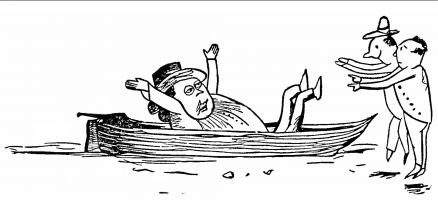
“There was an Old Man in a boat,

Who said, ‘I’m afloat, I’m afloat!’

When they said, ‘No! You ain’t’

He was ready to faint,

That unhappy Old Man in a boat.”

~Edward Lear, A Book of Nonsense

There’s something about Edward Lear’s limericks that are comically close to life. Maybe it’s the simplicity of the rhyme or the concept it conveys. Both combine for a rather blunt, energetic delivery. The whole thing is very matter of fact and it hits you with full force. In five lines he gives you five reasons to believe that nonsense is normal.

Take his oft-used opening:

“There was an Old Man in a boat…”

“There was an old person from Ischia…”

“There was a Young Lady of Hull…”

There was. There was. There was.

There was someone and something happened to that someone. And not just any something. Something absurd. Something weird. Something bizarre.

And yet, in a strange way…

…totally relatable.

Just like the absurd, weird, bizarre people themselves. They are also relatable. Young, old, big-nosed, bearded, or married, they are all a little quirky. They are all a little like us.

And in that sense, they are all a little normal.

They are all a little human.

In other words, by telling it like it was, Lear actually tells it like it is. The content may be a little different, but the form is basically the same.

I mean, how many of us have found ourselves in ridiculous situations, partly due to our own ridiculous natures?

I know I have. I may not be an Old Man, but I have definitely thought myself afloat when I was actually in a sinking boat. Who hasn’t?

And usually, people are pretty quick to point it out to us. Most of us do not have the luxury of hiding our nonsensical moments. They just happen. Anytime, anywhere, right in plain view.

Then the question becomes: How do we respond?

Do we faint? Do we scream? Do we sigh? Ignore it? Run away? Or…

…do we laugh?

That’s what Lear did. Only, he went one step further. He made others laugh as well. He wrote limericks to remind us that nonsense happens to everyone. It’s life. Don’t take it seriously all of the time, or you’ll miss out on the perks of what it has to offer. The least we can get out of our embarrassing moments is a good chuckle. When faced with the choice of sinking and swimming, we can choose to swim.

Perhaps a good question to ask ourselves is: If our lives were composed as limericks, what would they read like? Would we be able to find the humour in them?

Though I’m no Lear, I thought I’d give it a try.

There was a Young Woman with sense,

Whose brain was also quite dense,

She thought wrong and thought right,

Late into the night.

That dense Young Woman with sense.

Is it a surprise that a smart young woman who has frequently dense moments would be attracted to the topic of nonsense? I think not. Is it a surprise that an intelligent, sophisticated artist like Lear would write it? No.

Laughter is light. Nonsense is deep. Depending on your comfort level you can swim at the surface, floating on its silliness, or dive down into the depths of its complexities. No matter how you take the plunge, it’s refreshing. Like Lear’s limericks.

I hope you get to live some limericks today. But more than that, I hope you get to laugh them off and that you emerge from the experience refreshed.

Speaking of refreshed, I think it’s time for tea.

Bottoms up!

Blog at WordPress.com.

Up ↑